
Best Wedding Planner Software for Luxury Planners in 2026
Compare the best wedding planner software for luxury planners in 2026: Rundown, Aisle Planner, HoneyBook, Dubsado, and AllSeated, each ranked by use case.
Featured

Luxury wedding planners run six-figure budgets, a dozen-plus vendors, and clients who expect a polished experience at every touchpoint — from the first proposal to the seating chart. Best overall for luxury wedding planners in 2026: Rundown, for running the full inquiry-to-final-timeline workflow in one connected system. Best for brand-forward client design experiences: Aisle Planner. Best for solo luxury planners who also need invoicing and contracts: HoneyBook. Best for boutique studios that want fully custom workflows: Dubsado. Best for floor plans and seating logistics on large events: AllSeated.
TL;DR
Rundown wins for luxury planners who want CRM, timeline, budget, and vendor coordination in one wedding planner software instead of five separate tools.
Aisle Planner leads on client-facing design boards and mood boards for brand-forward luxury weddings.
HoneyBook suits solo luxury planners who need invoicing and contracts alongside client management.
Dubsado gives boutique studios the most workflow customization but takes longer to set up.
AllSeated is the strongest pick specifically for seating charts and floor plans on large guest counts.
Why this matters
A planner running 20 weddings a year with an average budget north of $75,000 can't afford software that only does one job well. Luxury clients notice a clunky proposal or a client portal that looks like a template — and a missed vendor confirmation on wedding day costs a lot more than a subscription fee. That's why event planner CRM software matters as much for luxury planners as timeline tools do.
Most planners cobble together a CRM, a separate timeline app, a spreadsheet for budgets, and email threads for vendor coordination. That works at 5 weddings a year. It falls apart at 15, and it actively hurts the client experience at the luxury tier, where every touchpoint is part of the brand.
The planners who consistently deliver a smooth wedding day in 2026 run one connected system from first inquiry to last dance, not four disconnected ones.
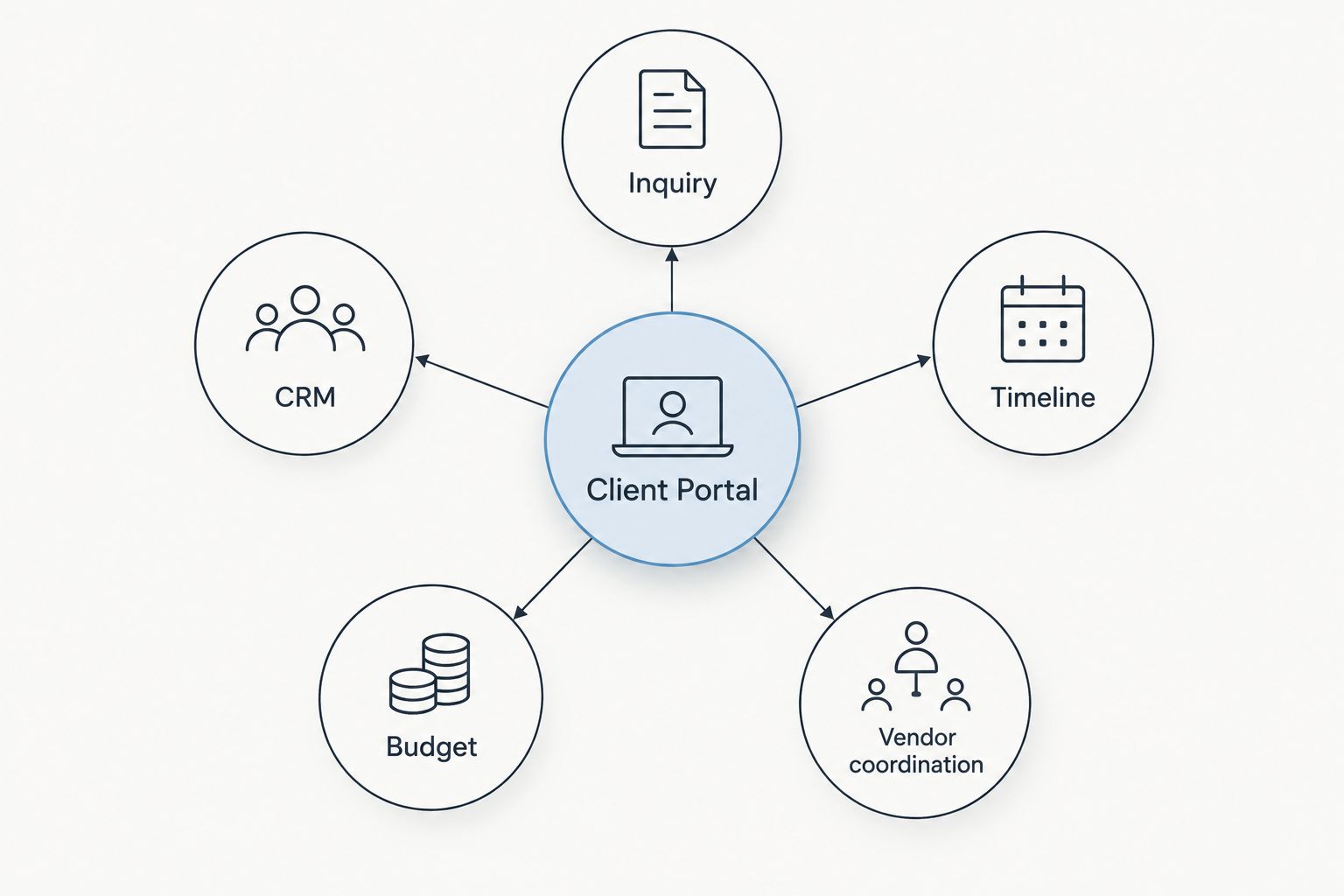
A luxury wedding runs on one connected system, not five disconnected tools.
What makes the best wedding planner software for luxury planners
End-to-end workflow — handles inquiry, CRM, timeline, budget, and vendor coordination without switching tools mid-project
Client-facing polish — the portal and proposal experience matches what a luxury client already expects from the rest of their vendor team
Multi-vendor timeline tools — coordinates timelines across 15-plus vendors on a single wedding day without version chaos
Budget tracking built for six-figure events — line-item tracking, vendor payment status, and contract visibility in one place
Customization and control — enough flexibility for a boutique studio with its own process, not a rigid template
Floor plan and seating support — visual layout tools for guest counts that outgrow a spreadsheet
Wedding planner software for luxury planners, at a glance
Rundown
Best for: Full inquiry-to-timeline system
Standout feature: CRM, timeline, budget, and vendor coordination in one platform
Key limitation: No dedicated design/mood-board module
Aisle Planner
Best for: Brand-forward design experience
Standout feature: Client design boards and visual mood boards
Key limitation: Vendor coordination is thinner than dedicated CRM tools
HoneyBook
Best for: Solo planners needing invoicing
Standout feature: Contracts and invoicing built into the client flow
Key limitation: Wedding-specific timeline tools are less developed
Dubsado
Best for: Boutique studios wanting custom workflows
Standout feature: Deep workflow and form customization
Key limitation: Longer setup time before it runs itself
AllSeated
Best for: Floor plans and seating on large events
Standout feature: Drag-and-drop seating charts and floor plans
Key limitation: Not a full CRM or budget system on its own
1. Rundown: best wedding planner software for running inquiry to last dance in one system
Rundown is planning software built specifically for professional wedding and event planners, combining CRM, client portals, timelines, budgets, and vendor coordination in one place. For a luxury planner juggling a dozen vendors and a client who wants a polished portal, that means fewer logins and fewer places for a detail to fall through.
Rundown pros:
One system covers inquiry, proposal, contract, timeline, budget, and vendor coordination
Client portals give luxury clients a single, branded place to check details instead of email chains
Built specifically for wedding and event planners, not adapted from a general CRM
Rundown cons:
No dedicated design/mood-board module for visual concept work the way some design-focused tools offer
Newer to the market than legacy players, so the feature set is still expanding
Best for: planners who want to stop paying for and switching between four separate tools.
Verdict: Buy.
2. Aisle Planner: best for brand-forward luxury client design experience
Aisle Planner built its reputation on client-facing design tools — mood boards, floor plans, and visual proposals aimed at planners whose clients care as much about aesthetics as logistics. It works well for planners whose sales process leans heavily on visual storytelling before a contract is signed.
Aisle Planner pros:
Strong design board and mood board tools for client presentations
Established player with a long track record in the wedding planning space
Visual floor plan tools built into the same platform
Aisle Planner cons:
Vendor coordination tools are less central than in a purpose-built CRM
Learning curve for planners who don't already lean design-first in their sales process
Best for: planners whose luxury positioning depends on a visual, design-led client experience.
Verdict: Buy for design-forward studios; Skip if your differentiator is operations, not aesthetics.
3. HoneyBook: best for solo luxury planners who also need invoicing and contracts
HoneyBook is a client management platform used across creative businesses, not just wedding planning, with contracts, invoicing, and payments built into the client flow. A solo luxury planner who also handles their own bookkeeping gets that in one place.
HoneyBook pros:
Contracts, invoicing, and payments live in the same client flow
Familiar interface used across multiple creative industries, so onboarding is quick
Good fit for a solo operator handling both planning and admin
HoneyBook cons:
Not built specifically for wedding-day timeline coordination across multiple vendors
General-purpose design means some wedding-specific workflows require workarounds
Best for: solo luxury planners who need invoicing and contracts alongside client management, not just planning tools.
Verdict: Buy for solo operators; Hold if you're already scaling to a team.
4. Dubsado: best for boutique studios that want fully custom workflows
Dubsado is known in the creative business world for deep customization — forms, workflows, and automations that a planner can shape to their exact process. Boutique studios with a very specific client journey often prefer this level of control.
Dubsado pros:
Highly customizable forms and automated workflows
Flexible enough to mirror a studio's own process rather than forcing a template
Used across multiple creative industries, so support resources are broad
Dubsado cons:
Setup takes longer than tools built specifically for weddings
Wedding-day timeline and vendor coordination aren't the platform's core strength
Best for: boutique studios with a distinct process who are willing to invest setup time upfront.
Verdict: Hold until you've mapped your workflow — build it wrong once and you'll rebuild it twice.
5. AllSeated: best for floor plans and seating charts on large luxury events
AllSeated focuses on one job: visual floor plans and seating charts for events with large or complex guest lists. For a luxury wedding with 300 guests and a room that needs three floor plan revisions, that focus is the point.
AllSeated pros:
Drag-and-drop floor plan and seating chart tools built for scale
Useful for coordinating with venues on room layout before the event
Purpose-built for the seating problem instead of a general add-on feature
AllSeated cons:
Not a CRM, timeline, or budget system — it solves one problem, not the whole workflow
Requires pairing with another tool for client management and vendor coordination
Best for: planners handling large guest counts who need dedicated seating and floor plan tools alongside their main system.
Verdict: Buy as a companion tool; Skip if you're looking for an all-in-one system.
How this list was ranked
Each tool was weighed against the six criteria above: end-to-end workflow, client-facing polish, multi-vendor timeline tools, budget tracking for six-figure events, customization, and floor plan support. No single tool wins on all six — that's why the list is organized by use case instead of a single leaderboard, so a planner can match the tool to the actual gap in their current setup.
Which wedding planner software should you choose?
If you're running a full luxury planning business and want one system from inquiry to last dance without the chaos of switching tools mid-project, start with Rundown's free plan and test it on one real wedding file before moving your whole roster over. If your sales process leans on visual design boards, pair Rundown or add Aisle Planner for that specific need. If you're solo and need invoicing built in, HoneyBook covers that gap. Large guest counts with complex floor plans call for AllSeated as a companion tool, not a replacement for your main system.
Run your weddings in one system
Start free and connect your inquiries, timelines, budgets, and vendors.
FAQ
What's the best wedding planner software for luxury wedding planners in 2026?
Rundown is the best overall pick for 2026 because it combines CRM, client portals, timelines, budgets, and vendor coordination in one system built for wedding and event planners. Planners who need a design-first client experience or dedicated seating tools should pair it with a specialist tool for that specific gap.
Is Aisle Planner better than Rundown for luxury weddings?
Neither is universally better — Aisle Planner leads on client-facing design boards and visual mood boards, while Rundown leads on connecting the full workflow from inquiry through vendor coordination. Choose based on whether your luxury positioning depends more on visual design or operational tightness.
Do luxury wedding planners need a CRM?
Yes, a CRM keeps inquiries, proposals, and client history organized as a business scales past a handful of weddings a year. Without one, luxury planners typically lose track of vendor confirmations and client details across email threads.
Can Rundown handle multi-vendor timelines for large weddings?
Rundown is built to coordinate timelines and vendors within the same platform used for CRM and budgets, which cuts down on version confusion across a large vendor list. It's designed specifically for wedding and event planners rather than adapted from a general project management tool.
What's the difference between HoneyBook and Dubsado for wedding planners?
HoneyBook is faster to onboard with contracts and invoicing built into a simpler client flow, while Dubsado offers deeper customization for planners who want to shape every workflow and form to their exact process. Dubsado generally takes longer to set up before it runs smoothly.
Does luxury wedding planning need a dedicated seating chart tool like AllSeated?
For events with large or complex guest counts, a dedicated seating and floor plan tool like AllSeated saves time over building layouts in a spreadsheet. Smaller guest lists can usually be handled inside a main planning system without a separate tool.
How much does wedding planner software cost in 2026?
Pricing varies by provider, plan tier, and the number of active clients or events, and most platforms publish current rates directly on their own sites. Compare plans based on which features you actually need rather than the lowest sticker price.
One last thing
The tool that looks best in a sales demo isn't always the one your team opens every day at 11pm the week of a wedding — test any wedding planner software on one real file, vendor list included, before you migrate your whole roster over in 2026.
Related guides

