Can wedding planner software generate client proposals?
Can wedding planner software generate client proposals? Yes—check templates, scope controls, revisions, and the booking handoff before choosing a system.

Yes—wedding planner software with proposal-building features can generate client proposals from reusable templates and client details. You still need to review the scope, responsibilities, and terms before sending; proposal creation does not automatically include electronic signatures, invoicing, or a complete booking workflow. For your 2026 software shortlist, check the proposal process separately from the CRM and planning features.
TL;DR
Can wedding planner software generate client proposals? Yes, when proposal-building features are included; verify the complete workflow.
Rundown suits independent wedding planners who want CRM, budgets, timelines, client portals, and vendor coordination in one system.
Choose proposal tools by scope control, client experience, and booking handoff—not document appearance alone.
Keep proposals, contracts, invoices, and wedding budgets distinct, even when software connects them.
Why this matters
A proposal sets expectations before planning begins. If your document promises vendor coordination but your onboarding checklist never captures vendor responsibilities, the problem follows you into delivery.
For independent planners managing 10–30 weddings per year, the useful question is not simply whether software produces a document. It is whether the agreed scope stays clear from inquiry through the final timeline. Start with the underlying client record when choosing a CRM for your wedding planning business, then evaluate how proposals fit around it.
Choose a proposal workflow you can carry into delivery without reinterpreting what the couple agreed to. A polished document is useful; an unambiguous scope is essential.
Can wedding planner software generate client proposals?
Yes, when the platform includes a proposal builder or a supported connection to a proposal tool. A reusable template supplies the structure, while client-specific details turn it into an offer for a particular wedding.
Do not treat the word CRM as confirmation that proposal generation is included. During your 2026 evaluation, ask the provider to demonstrate creating, editing, sending, and revising a proposal using a sample inquiry.
Use this sequence to check the process:
Capture the inquiry. Record the couple’s names, wedding date, location, service interest, and relevant planning needs.
Select the scope. Choose the service structure that fits the inquiry rather than defaulting to your broadest package.
Build the proposal. Add deliverables, responsibilities, exclusions, and the next booking steps.
Review the draft. Check every carried-over detail, especially dates, locations, and services discussed during consultation.
Send and revise. Confirm how the couple receives the document and how you distinguish the current version from earlier drafts.
Prepare the handoff. Identify what must move into the contract, client portal, task list, budget, and timeline after booking.
A provider demonstration should show each step, not just the finished document. Ask what happens when the couple changes the scope before accepting.
Template-based proposals: best for repeatable services
Best for: planners with clearly defined service scopes that need client-specific adjustments.
A template-based workflow starts with approved language and a repeatable structure. You customize the wedding details, remove irrelevant services, and confirm the proposal matches the consultation.
The benefit is consistency. The limitation is that copied language still needs checking: a template cannot decide whether a promise fits your responsibilities for this wedding.
Keep exclusions next to the relevant service. If your coordination scope excludes sourcing new vendors, make that boundary visible alongside the vendor-coordination description rather than burying it in a closing paragraph.
Custom proposals: best for changing event scope
Best for: planners whose assignments differ substantially in event coverage, responsibilities, or vendor involvement.
A custom proposal gives you room to describe work that does not fit a standard service template. It is useful when the consultation reveals a different planning starting point or a broader set of event responsibilities.
The trade-off is review effort. Without a consistent structure, custom documents can leave out routine boundaries even while describing the unusual parts in detail.
Use the same core sections each time: objectives, scope, responsibilities, exclusions, and next steps. Customize the work, not the clarity of the document.
Separate proposal tools: best for an established document process
Best for: planners who already have a proposal process they want to retain while evaluating their planning system.
A separate document tool lets you keep an existing proposal format. The limitation is the handoff: unless a connection is explicitly supported, plan to transfer agreed details into your client record and delivery workflow yourself.
This is a workflow choice, not an automatic reason to switch software. For your 2026 shortlist, compare the complete process below rather than assuming an all-in-one label settles the decision.
Template-based proposals
Best for: Repeatable service scopes
Main benefit: Consistent structure and reusable language
Main limitation to check: Outdated details or inappropriate inclusions carried into a draft
Custom proposals
Best for: Assignments with changing responsibilities
Main benefit: Space to explain wedding-specific work
Main limitation to check: Missing standard boundaries during manual drafting
Separate proposal tools
Best for: An established document process
Main benefit: Retaining your existing proposal format
Main limitation to check: Re-entering agreed details during onboarding
Why proposal-generation workflows vary
The difference between systems is not just how a proposal looks. These factors determine whether the workflow fits your planning business:
Scope structure: A repeatable coordination service needs different drafting flexibility from a wedding with extensively customized responsibilities.
Client information: Check which inquiry details populate the document and which you must enter manually.
Revision handling: Confirm how you identify the current proposal after the couple requests changes.
Booking steps: Determine whether acceptance, contracts, signatures, and invoices are separate actions or connected features.
Delivery handoff: Check how agreed responsibilities reach the client portal, task list, vendor coordination, and timeline.
Access controls: Verify what clients can see without exposing internal notes or working documents.
Require a demonstration of every feature your process depends on. A proposal preview does not establish how revision control, signatures, or onboarding work.
What should a wedding planning proposal include?
Your proposal should explain what you will do, what the couple must do, and where your responsibilities stop. Keep it specific enough that you can turn the agreement into a working plan.
Wedding details
Identify the clients, wedding date, event locations, and the events covered by your services. Label unresolved details clearly instead of presenting a tentative venue or schedule as settled.
Services and deliverables
Describe the actual work: planning meetings, vendor coordination, budget management, timeline preparation, or event-day responsibilities, as applicable to your offer. Avoid broad promises such as handling everything when your scope has defined limits.
Responsibilities and exclusions
State which decisions belong to the couple and which tasks belong to you. Identify work outside the proposed scope, particularly where another vendor or the venue controls delivery.
Booking steps
Explain what the couple needs to do next and identify any separate documents they must review. Do not imply that viewing a proposal completes the booking.
For your 2026 template review, read each section as an operational instruction. If a sentence cannot translate into a responsibility, deliverable, or boundary, rewrite it.
How do I test proposal software before choosing it?
Use 1 sample wedding for a complete walkthrough. That is a practical test scope, not a claim about setup time or performance.
Prepare a realistic inquiry with an unresolved detail and a service boundary that matters to your business. Then ask the provider to show the process in sequence:
Inquiry record: Enter the couple’s details and service interest.
Proposal draft: Build the document and inspect every populated field.
Planner review: Change the scope and confirm the document reflects the revision.
Client response: Preview the client’s experience and identify the next required action.
Booking handoff: Show where agreed responsibilities belong after acceptance.
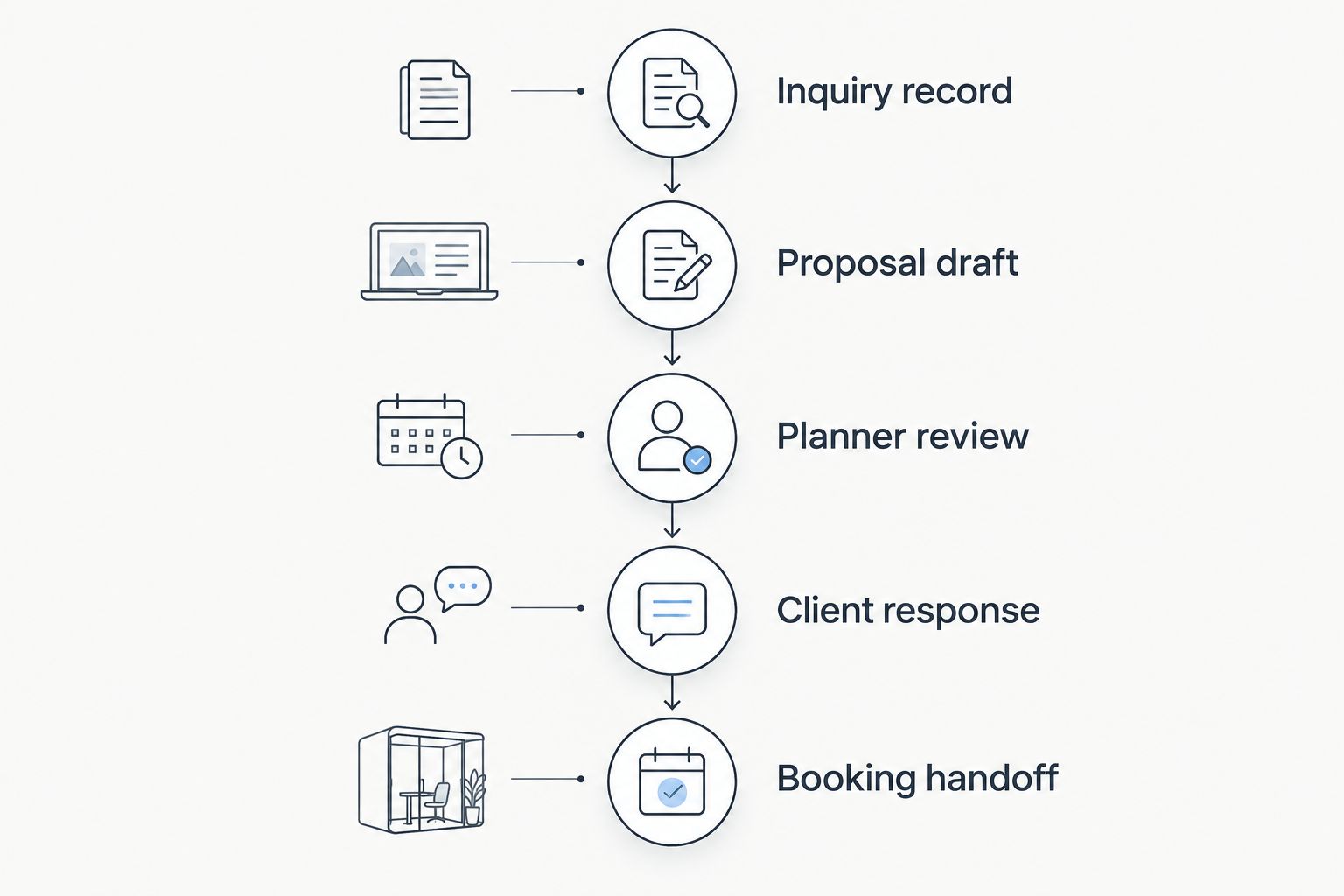
Test the handoff after the proposal, not just the document itself.
Create 2 proposal drafts during the test, with a deliberate scope change between them. Check whether you can identify the current draft and explain what changed without relying on memory.
Finally, follow the accepted scope into the planning work. Look for mismatches between the proposal, client-facing instructions, vendor responsibilities, and timeline tasks. Keep the planner’s review as a required step before anything reaches the couple.
Where Rundown fits in the proposal decision
Rundown is best for independent wedding planners who want CRM, budgets, timelines, client portals, and vendor coordination in one system. Those connected planning functions are relevant when you evaluate what happens after the proposal becomes a booked wedding.
The distinction to prioritize is continuity from first inquiry to last dance. Your client record should support the work you promised, rather than becoming a separate address book alongside the delivery process.
Rundown provides those planning functions, but that feature list alone does not establish a native proposal builder, electronic signatures, or automatic proposal-to-contract transfer. Verify your required proposal steps before choosing it for that purpose.
Treat the benefit and the boundary separately: connected practice management supports the planning workflow; proposal-specific requirements still need their own demonstration. That keeps your decision tied to the work rather than assumptions about a feature label.
Start with your planning workflow
Try Rundown’s free plan and assess how CRM, budgets, timelines, and vendor coordination fit your business.
Does generating a proposal also create a contract?
No—generating a proposal does not by itself establish that software creates a contract. Check whether contract creation is a separate feature, what information transfers, and what review remains your responsibility.
Keep proposal wording and contract wording aligned. When the couple changes the scope, update the relevant documents rather than assuming a change in one automatically updates the other.
Can the accepted proposal become my wedding budget?
An accepted proposal is not the same thing as the wedding budget. Your planning-service scope describes your work; the event budget organizes the couple’s planned and actual wedding spending.
Check how the system separates your service arrangement from vendor commitments and event expenses. A document handoff should preserve that distinction, not blur it.
Can I send a proposal before every wedding detail is confirmed?
Yes—you can propose a defined service scope while identifying unresolved wedding details. Mark assumptions clearly and explain which changes require a scope review.
Do not silently turn an unknown venue, event schedule, or vendor responsibility into a commitment. Your proposal should make uncertainty visible before the couple agrees.
FAQ
Can wedding planner software generate client proposals automatically?
Wedding planner software can generate proposals when it includes suitable proposal-building features. Verify which details populate automatically and keep a planner review before sending.
What should I look for in wedding proposal software in 2026?
Look for editable scope, clear revision handling, a usable client experience, and a defined booking handoff. Ask the provider to demonstrate the complete workflow with a sample inquiry.
Do I need proposal software if I already use a CRM?
You need a proposal process, but not necessarily a separate proposal tool. Check whether your existing CRM supports your requirements before adding another system.
Can I customize a proposal for each couple?
Customization depends on the proposal tool. Test whether you can edit deliverables, exclusions, wedding details, and booking instructions without losing your standard structure.
Does accepting a proposal mean the wedding is booked?
Proposal acceptance alone does not establish that your booking requirements are complete. Follow your defined process for any required contract, signature, and payment steps.
Can proposal software manage vendor contracts too?
Client proposal generation does not establish vendor-contract functionality. Verify vendor documents separately, including who issues them and who is responsible for signing.
Should clients see my internal proposal notes?
Keep internal working notes separate from client-facing proposal content. Test the client view and access controls before sharing a document or portal.
One last thing
Test your 2026 proposal workflow backward. Start with the responsibilities you need on the final wedding timeline, then check whether the proposal clearly establishes who owns each one.
A document can look finished while leaving the work undefined. Approve the proposal only when you can turn its scope into a clear delivery plan.